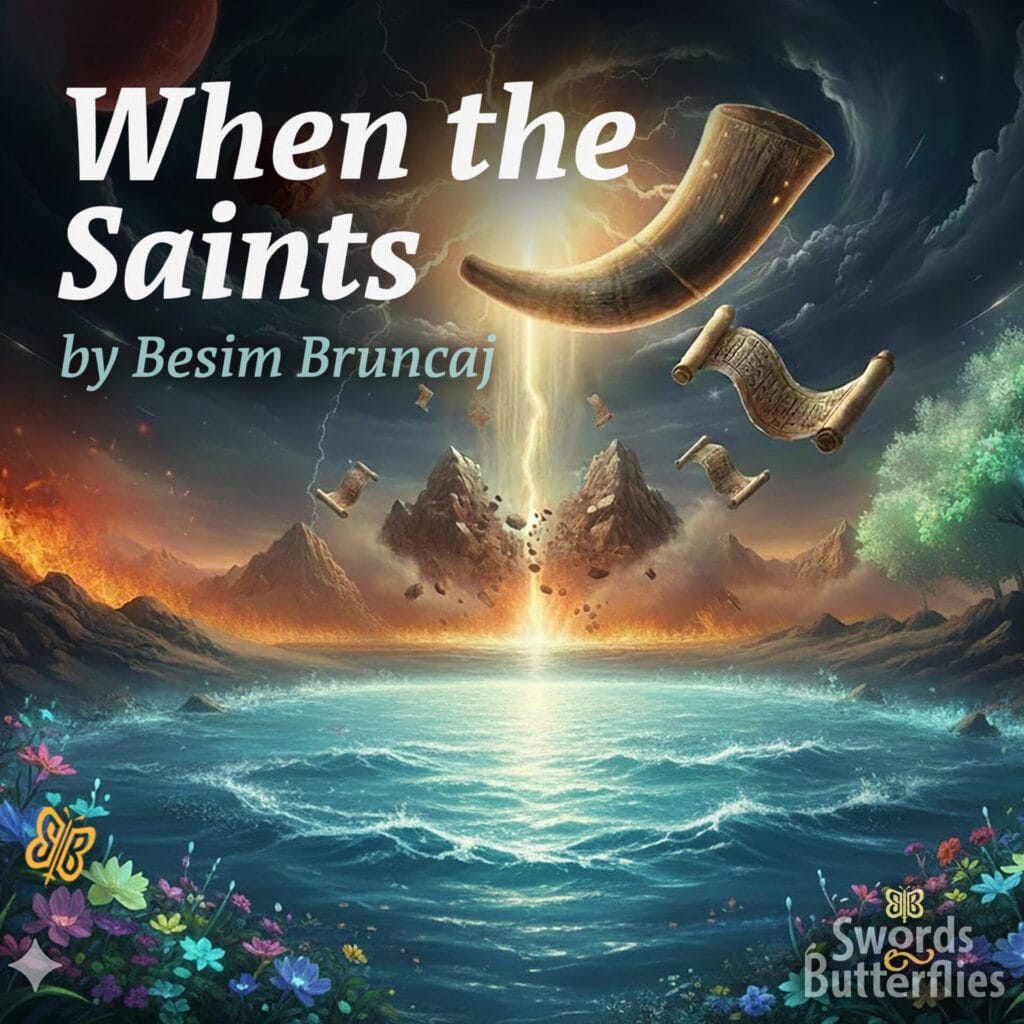
We are excited to announce a new nasheed that is different from our previous ones. While our first releases focused on songs for young children, this one is for older children and adults, based on the American spiritual classic “When the Saints.”
The lyrics pull straight from the Qur’an, in particular the order of events on the Final Day from Surat al-Takwir. The sun folds up. Stars plunge into darkness. Mountains blow away like dust. Seas turn to fire. The Trumpet blasts, and souls stand exposed. Buried infant girls rise to ask, “What was my crime?”
At first, this might seem an odd theme to make into a nasheed. However, this was also the subject of the early “When the Saints” tunes, where various verses began with lines such as these:
Oh, when the stars fall from the sky
Oh, when the sun refuse to shine
Oh, when the moon turns red with blood
Oh, when the trumpet sounds its call
The third and fourth verse lines would then pivot from these scary scenes to one of hopeful prayer:
Oh Lord I want to be in that number
When the saints go marching in.
It’s standing as a classic, long before being secularized in 1955 when Bill Haley & His Comets recorded their Rock & Roll version, comes from this emotional back of forth of flying between fear and hope, two essential attributes of every believer. However, in our version, after each verse hits hard, it then returns with various repetitions of dua such “Rab-bi make me please be with the Nabi” or “O Lord, may I be with Nabi Muhammad.” The chorus echoes: “When the saints lead us to him.”
Despite the steady stream of terrifying images from the Quran, the final line of each scene changes everything. It turns from fear to hope. All the Prophets running straight to the Prophet ﷺ on that day, who provides us intercession on the day of horrors. He stands before Allah, prostrates, then lifts his head in perfect praise. With those blessed lips he pleads for us. His hands draw from the Hawd. The plea shifts: “Allah, amass us with our Master Ahmad” or “keep me with Sayyidi Yaseen.” It moment of fear ends with a plee of longing and optimism.
The original song had a similar view.
The original song is apocalyptic, taking much of its imagery from the Book of Revelation, but excluding its more alarming depictions of the Last Judgment. The verses about the sun and moon (often interpreted as solar and lunar eclipses) correlate to prophecy in the Book of Joel, which is also referenced by the Apostle Peter in Acts of the Apostles: (“The sun will be turned to darkness and the moon to blood before the coming of the great and glorious day of the Lord”). The trumpet is the way in which the Last Judgment is announced. As the hymn expresses the wish to go to Heaven, picturing the saints going in (through the Pearly Gates), it is sometimes played at funerals.1
There is a great benefit to this kind of song. First, it mirrors the Quranic paradigm where many of the most essential short suras that children learn, such as the Fatiha, al-Falaq, al-Nas, Masad, al-Humaza, etc. all deal with dualing themes of good and evil, fear and hope, heaven and hell.
Secondly, it honors true feelings and thoughts of patterns of children. Instead of ignoring the inevitable lived experiences of fear and pain and focusing solely on happy thoughts, Allah teaches us to actually help shape how we must view more challenging experiences of fear and evil, namely by returning to Him, jalla jalalahu and His noble prophet, peace be upon him.
This nasheed speaks directly to Muslim families in the West. Kids hear pop songs everywhere. Songs full of evil vice and vileness. As parents, we all want something not only clean, but deeper and profound. Something paradigm shifting. Something that plants love for Allah and His Messenger ﷺ even in the most difficult of circumstances. Nasheeds like this one do that work quietly, by planting seeds of eternal bliss found in returning to our Beloved.
Picture this. Voices rise in layers—no instruments except the pulse of daf drums, the sharp snap of fingers, and background harmonies. The ensemble marches forward like an old Black spiritual choir, but every line turns toward the Prophet Muhammad ﷺ. The sound builds slow, then swells into something heavenly. It feels like a march through the end of time.
Young children learn through sound first. Rhythm sticks. Repetition carves deep. Simple refrains teach big truths. Kids memorize the meanings of Surat al-Takwir without feeling forced to. They learn to seek increase love of the Prophet ﷺ without effort. You will see them drawing when they randomly start singing out lines from songs they’ve learned, “O Lord, may I be with Nabi Muhammad.” The march beat makes our march to paradise seem inevitable.
Muslim societies have always used nasheeds and qasidas. Some Sahaba were commanded to turn poetry into defense of faith and praise of the Prophet ﷺ. Over centuries, people adapted local styles—adding various modes and rhythms that suite their native language and culture. The core stayed uniquely local and rich. This piece follows that path. It takes the Black spiritual march and fills it with Islamic longing.
That is why Swords & Butterflies makes songs like this. We are building the first full Islamic ELA curriculum for elementary that captures both Islamic learning and the rich Western tradition. Our books teach English through seerah, akhlaq, and dua. No busy prep needed. Lessons fit homes, schools, or masjids. Classically metered and truly English Nasheeds support it all. Repetition builds strong memory. Melody carries Prophetic love. Kids gain language skills and iman at once.
Play “When the Saints” today. Let it fill the room. Share it with your children. Reflect on the day we all march toward. Make dua to be among those led by the righteous to their beloved Nabi ﷺ. May Allah accept this nasheed as a means to draw us closer to Him and His Messenger.